
How to use ChatGPT to write a customised murder mystery game
12 min read Updated 7 April 2026
Can ChatGPT Write a Murder Mystery Game? The Truth About AI Game Design
Over the last few years, AI tools like ChatGPT and Google Gemini (formerly Bard) have evolved into sophisticated language models. While they are incredible tools for creative writing, there is a growing trend of users trying to use ChatGPT to write a customised murder mystery game from scratch.
The truth? AI isn’t quite there yet. While ChatGPT is a massive boon for speeding up the creative process, you cannot fully remove the human element from game design. To create a game that actually works, you need a human creative in the mix to ensure logic, flow, and player engagement.
I’m not saying this because I want you to you use our services. Far from it! We can’t write bespoke murder mysteries for everyone! Heck, we already struggle with all the requests we get in day to day as it is… but it’s important to recognise that AI is a tool. Somewhere in the design process you are going to need a “real person” with some element of skill to create can experience that will both WORK and be enjoyable. There is no reason this “person” couldn’t be you!
Why You Need a Human-in-the-Loop for Game Creation
AI can brainstorm ideas, craft detailed backstories, and develop personality traits for your suspects. In some instances, it can even help with plot points. However, relying solely on AI for an engaging murder mystery is a mistake for several reasons:
- Framework is Essential: AI understands patterns, but it doesn’t understand “playability.”
- Logic over Fiction: AI is trained on stories (which use “twist” tropes), whereas games require a solvable logic path.
- <>The “Garbage In, Garbage Out” Rule: If you don’t understand the framework of a murder mystery, you won’t know how to prompt the AI to give you the components you actually need.
If you’re planning to ask ChatGPT to write your game for you – then you really need at least a basic understanding of the different types of murder mystery games out there and how they work.You can find an introduction to the different sorts of murder mystery games on this blog: What are the different murder mystery game types
Master the Framework: “How to Write a Murder Mystery”
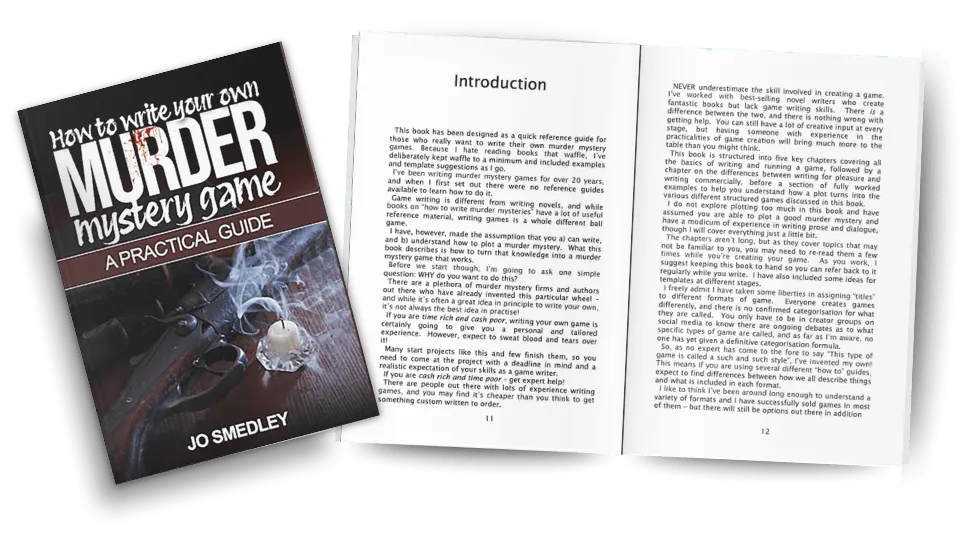
And if you would like to create your own murder mystery with or without the help of ChatGPT then I’d urge you to take a look at our murder mystery games book – where I’ve detailed EVERYTHING you need to know to write a murder mystery and provided a number of worked examples. The book will help you get what you need from ChatGPT. It doesn’t cover how to use ChatGPT in creation, but understanding a murder mystery framework will mean you can create with ChatGPT as your helper, asking it for the specifics you need for each step rather than expecting it to create something from nothing, which it isn’t really capable of yet.
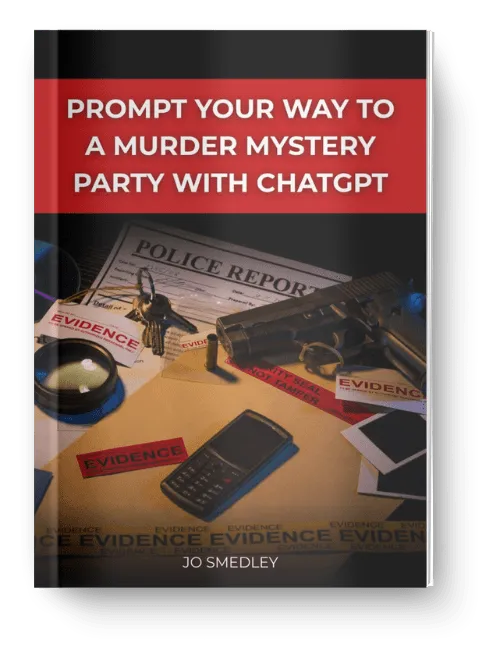
Want more help prompting your murder mystery game with ChatGPT?
If you understand the basics but need help turning your ideas into effective prompts, take a look at our new short guide, Prompt Your Way to a Murder Mystery Party with ChatGPT.
It guides you through using ChatGPT as a creative assistant to develop your theme, characters, motives, clues and party materials, while keeping you in control of the structure and playability of the game.
6 Critical Fixes When ChatGPT to Write a Custom Murder Mystery Game
If you are dead set on letting AI take over the creative process entirely then watch out for the following in the output you get – and make sure you fix this on an edit:
1. Emotional Nuance and Human Connection
Murder requires an emotional drive of some sort. The average person does NOT run around killing someone for no reason. There has to be a very valid reason for resorting to murder. AI can generate a plot but only a human will know if it’s “good enough”.
Sometimes you need a multifaceted character, a depth of context. AI is great, but sometimes it just misses the mark.
Human writers understand layering, emotional context and know instinctively what will potentially drive someone over the edge. And also what another person is likely to be fooled by when you want some good red herrings in the mix. Humans are best at understanding humans. So make sure you review the output and tighten the drama, subtext and context.
2.Realism vs. The “Abrupt” Twist
Murder mystery games SHOULD (if plotted correctly) reveal all within the game, so that the solution is believable and satisfying.
AI models have been trained, by and large, on fiction which relies on “last minute reveals and surprising twists” to solve the case. This has, unfortunately, left AI a little behind the curve with game creation. A game master’s job is to reveal all while obscuring the truth and solution “pathway” with so many other plausible ideas that people are fooled into following the wrong trail and idea.
So make sure you complete a reality check on the output. Review the solution – could you have worked that out from the other information provided?
Be aware of AI’s idea of surprise twists, that aren’t so much “surprising twists” as abrupt left turns to a totally different idea no one could have foreseen.
AI is great at following patterns and it knows about the idea of “twists” but quite regularly is baffled by how to generate one that is in context and believable.
So make sure you proof the work to make sure the murder is believable, realistic and solveable, but also that there’s enough “surprise” in there to be entertaining and enjoyable.
3. Player Dynamics and Interaction
I’ve said this already – but a murder mystery game isn’t a story; it’s an interactive experience. Players are active participants, not passive readers, and their choices and interpretations shape the game’s trajectory. AI lacks understanding about how your friends will engage with the story.
You as a writer will bring your understanding of your guest’s psychology to the table. How will your players interact. What will they be comfortable with? Do they need a shared script Q and A or will they be able to think on their feet and just talk and question each other based on what AI has given them. Again – take a look at the book if you aren’t 100% sure yourself. I’ve been creating murder mystery games for over 17 years now and I’m still creating new formats to suit different players and dynamics and events.
I DO use AI to help with the sheer volume of stuff I need to write, but I edit EVERYTHING. I take ideas… half a sentence here, a description there, and I’m constantly tweaking. Nothing is used directly from the interface unless it’s just “padding context” e.g. I need a newspaper article. The article isn’t particularly important but springboards something else… as padding generation – AI is a BEES KNEES. I used to spend HOURS creating newspaper articles that no one would EVER read, especially for the back of newspapers. These days I just give AI a prompt and use what spits out. It has saved me DAYS of creative time!
4. Cultural and Contextual Sensitivity
AI is very good at generating information that might be logically coherent, but misses cultural or contextual nuances.
In a murder mystery game where themes of morality, justice, and social norms often come into play, getting these subtleties wrong can lead to a disjointed or even offensive experience.
A human author ensures that the story fits the group. You will bring along your cultural sensitivity, a deep understanding of context, and the ability to navigate complex themes responsibly.
5. Dialogue and “The AI Voice”
I have YET to see ChatGPT spit out any immediately useable dialogue. It’ll often create the odd great sentence or phrase, but it lacks the emotional context to deliver on the nose or comedic dialogue. Again if I’ve hit a brick wall on inspiration I’ll often get ChatGPT to have a go at it first, but I’ll then extensively edit, as I know no one would naturally speak like that!
6. Pattern Repetition
Chat still often gets stuck in a rut, and when it finds something it likes it’ll just regurgitate it over and over again. Suddenly ALL the suspects are being blackmailed, or every one of them has a strange limp. So when looking at the output to ensure that every character is subtly different and the motives aren’t all the same.
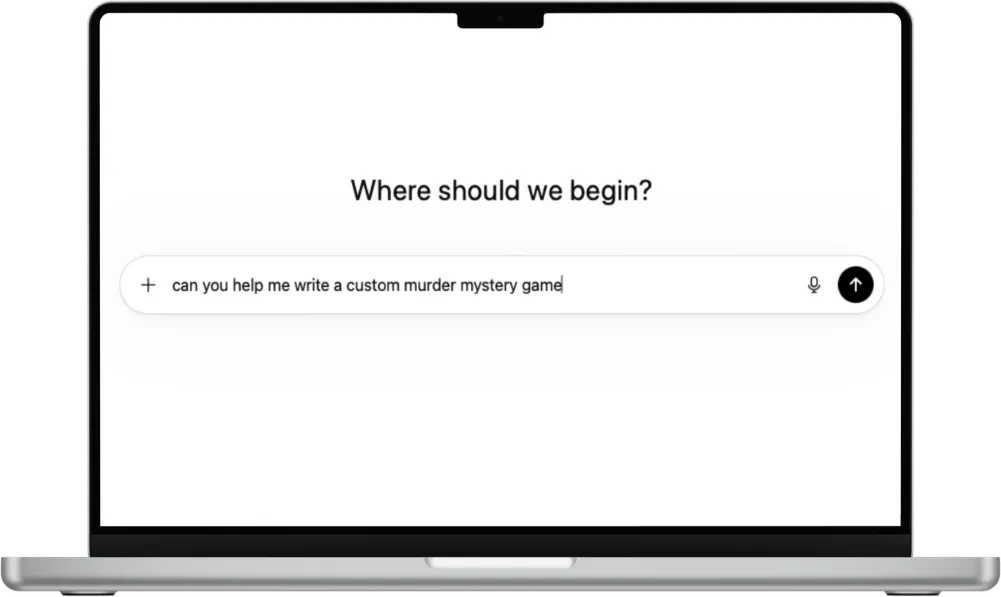
Best ChatGPT Prompts for Custom Murder Mystery Game Design
AI models like ChatGPT should not be ignored by game creators. They are of enormous help brainstorming plot lines, generating character descriptions, and giving you a starting point for some puzzle or riddle components, but I have yet to see one spit out a full murder mystery you could immediately use and it has yet to deliver any meaningful puzzle with a useable solution!
However if you want to short cut writing your own murder mystery by using ChatGPT then it will help you every step of the way but DON’T expect a finished game from one prompt. Instead work with it on very specific ideas at a time through specific prompts. And PLEASE make sure you know how to write a murder mystery game yourself, don’t expect chat to understand player dynamics or game structure!!
1. Start with the Basics: The Setting and Tone
Set the stage for your murder mystery by asking chat to help with defining the setting, era, and tone.
Example Prompt:
“Help me brainstorm a murder mystery set in a remote Victorian manor during a stormy night. The tone should be suspenseful with moments of dark humour. Can you outline a potential premise for the mystery?”
You might like it’s first idea, but don’t be afraid to ask for another 5 ideas, and then ask it to combine a few together, or pick the best of them all, mash them up and ask chat to rework it into a blurb for the mystery. Don’t be afraid to provide examples from literature. E.g. I’m trying to create a vampire plot that’s twilight in theme.
2. Flesh Out the Characters
Characters are essential to a good murder mystery. And you can use prompts to develop your characters, but it’s important to know WHAT you’re looking for. Do you just need a tiny bio blurb? Do you need a potted history for each character with their full background? Do you need what they were doing the day of the murder? Do you want personality traits or quirks?
Example Prompt:
“Describe five suspects for a murder mystery at a high-society gala. Include their backstories, motives, and possible secrets.”
I find giving chat an example of what I’m looking for will provide a better result. So I’ll often start the process and ask chat to improve it, or give it some headers and examples and ask it to generate in the same style. Again I’ve yet to use anything verbatim, but it’s been a good starting point!
Where it excels is at improving something I’ve already written, making it more concise or more exciting to read. Though if you’ve used chat yourself a lot, you’ll recognise how often things are “enigmatic”…!
3. Outline the Crime and Clues
You can ask Chat to outline or detail the crime itself and suggest clues for players to discover.
Example Prompts:
“Outline the murder in this story. Who is the victim, how were they killed, and what clues could I use to help solve the case?”
“Generate a list of five subtle clues that point to the real killer, but could be interpreted differently by players.”
4. Add Red Herrings and Twists
A good murder mystery needs misdirections and unexpected twists. I find chat isn’t always the best generator of these, and actually the best red herrings aren’t “herrings” but alternative solutions… but it will let you prompt, just be prepared to disregard what it might suggest as totally unworkable!
Example Prompt:
“Please provide two plausible red herrings that could mislead players in solving the mystery.”
5. Suggest Dialogue and Narration
Natural, engaging dialogue is very difficult to obtain from Chat models however it will often give you a starting point that you can then use to develop your ideas from. It’s always easier editing than it is to start with a blank page.
Example Prompts:
“Write a tense confrontation between two suspects, each trying to pin the blame on the other.”
“Draft a monologue for the killer when they are finally unmasked.”
6. Generate Materials
Get specific assets like newspaper articles, reports or item descriptions that you can use in your murder mystery to create an immersive experience with physical clues.
Example Prompts:
“Write a detailed description of a blood-stained letter found at the crime scene.”
“Suggest 5 “easy to obtain” physical objects that I can use to prompt thematic questions from the guests.
I hope this guide helps but we understand if making your own murder mystery games may not be your cup of tea. However, do not worry, we have got plenty of pre made murder mystery games ready for you and also bespoke events which can be customised by us with different themes/age ratings for all groups.

Get a Custom-Written Murder Mystery Game
Don’t have 17 years to master the art of the mystery? We do. If you need a game that is guaranteed to work, we offer bespoke murder mystery creation. We can write a custom game tailored to your specific theme, group size, and age rating.
For more guided prompts and practical support, explore our book, Prompt Your Way to a Murder Mystery Party with ChatGPT.
Using ChatGPT to Write a Murder Mystery Game FAQ’s
- What is the best way to use ChatGPT for murder mysteries? Use it as a brainstorming tool for backstories and assets, but maintain a human-led framework for logic and player dynamics.
- Can AI write a full murder mystery game? Not successfully. It lacks the understanding of game mechanics and “solvability” required for interactive experiences.
- How do you fix AI-generated plots? Focus on adding emotional nuance, correcting illogical twists, and diversifying character motives.